
The look-and-say sequence is the sequence of numbers 1, 11, 21, 1211, 111221, 312211, …, in which each term is constructed by “reading” the previous term in the sequence. For example, the term 1 is read as “one 1”, which becomes the next term: 11. Then 11 is read as “two ones”, which becomes the next term: 21, and so on.
The remarkable thing about this sequence is that even though it seems at first glance to be quite arbitrary and non-mathematical, it has some interesting properties that were unearthed by John Conway. Most notably, he showed that the number of digits in each term of the sequence on average grows by about 30% from one term to the next. A bit more specifically, he showed that if Ln is the number of digits in the nth term in the sequence, then

where λ is the unique positive real root of the following degree-71 polynomial:

In order to demystify this seemingly bizarre fact, in this post we will show where this polynomial comes from and prove that the above limit does indeed equal its largest root (which happens to be its one and only positive real root).
The Cosmological Theorem
What lets us formally study the look-and-say sequence is a rather ominous-sounding result known as the cosmological theorem, which says that the eighth term and every term after it in the sequence is made up of one or more of 92 “basic” non-interacting subsequences. These 92 basic subsequences are summarized in lexicographical order in the following table. The fourth column in the table says what other subsequence(s) the given subsequence evolves into. For example, the first subsequence, 1112, evolves into the 63rd subsequence: 3112. Similarly, the second subsequence, 1112133, evolves into the 64th subsequence followed by the 62nd subsequence: 31121123.
| # | Subsequence | Length | Evolves Into |
|---|---|---|---|
| 1 | 1112 | 4 | (63) |
| 2 | 1112133 | 7 | (64)(62) |
| 3 | 111213322112 | 12 | (65) |
| 4 | 111213322113 | 12 | (66) |
| 5 | 1113 | 4 | (68) |
| 6 | 11131 | 5 | (69) |
| 7 | 111311222112 | 12 | (84)(55) |
| 8 | 111312 | 6 | (70) |
| 9 | 11131221 | 8 | (71) |
| 10 | 1113122112 | 10 | (76) |
| 11 | 1113122113 | 10 | (77) |
| 12 | 11131221131112 | 14 | (82) |
| 13 | 111312211312 | 12 | (78) |
| 14 | 11131221131211 | 14 | (79) |
| 15 | 111312211312113211 | 18 | (80) |
| 16 | 111312211312113221133211322112211213322112 | 42 | (81)(29)(91) |
| 17 | 111312211312113221133211322112211213322113 | 42 | (81)(29)(90) |
| 18 | 11131221131211322113322112 | 26 | (81)(30) |
| 19 | 11131221133112 | 14 | (75)(29)(92) |
| 20 | 1113122113322113111221131221 | 28 | (75)(32) |
| 21 | 11131221222112 | 14 | (72) |
| 22 | 111312212221121123222112 | 24 | (73) |
| 23 | 111312212221121123222113 | 24 | (74) |
| 24 | 11132 | 5 | (83) |
| 25 | 1113222 | 7 | (86) |
| 26 | 1113222112 | 10 | (87) |
| 27 | 1113222113 | 10 | (88) |
| 28 | 11133112 | 8 | (89)(92) |
| 29 | 12 | 2 | (1) |
| 30 | 123222112 | 9 | (3) |
| 31 | 123222113 | 9 | (4) |
| 32 | 12322211331222113112211 | 23 | (2)(61)(29)(85) |
| 33 | 13 | 2 | (5) |
| 34 | 131112 | 6 | (28) |
| 35 | 13112221133211322112211213322112 | 32 | (24)(33)(61)(29)(91) |
| 36 | 13112221133211322112211213322113 | 32 | (24)(33)(61)(29)(90) |
| 37 | 13122112 | 8 | (7) |
| 38 | 132 | 3 | (8) |
| 39 | 13211 | 5 | (9) |
| 40 | 132112 | 6 | (10) |
| 41 | 1321122112 | 10 | (21) |
| 42 | 132112211213322112 | 18 | (22) |
| 43 | 132112211213322113 | 18 | (23) |
| 44 | 132113 | 6 | (11) |
| 45 | 1321131112 | 10 | (19) |
| 46 | 13211312 | 8 | (12) |
| 47 | 1321132 | 7 | (13) |
| 48 | 13211321 | 8 | (14) |
| 49 | 132113212221 | 12 | (15) |
| 50 | 13211321222113222112 | 20 | (18) |
| 51 | 1321132122211322212221121123222112 | 34 | (16) |
| 52 | 1321132122211322212221121123222113 | 34 | (17) |
| 53 | 13211322211312113211 | 20 | (20) |
| 54 | 1321133112 | 10 | (6)(61)(29)(92) |
| 55 | 1322112 | 7 | (26) |
| 56 | 1322113 | 7 | (27) |
| 57 | 13221133112 | 11 | (25)(29)(92) |
| 58 | 1322113312211 | 13 | (25)(29)(67) |
| 59 | 132211331222113112211 | 21 | (25)(29)(85) |
| 60 | 13221133122211332 | 17 | (25)(29)(68)(61)(29)(89) |
| 61 | 22 | 2 | (61) |
| 62 | 3 | 1 | (33) |
| 63 | 3112 | 4 | (40) |
| 64 | 3112112 | 7 | (41) |
| 65 | 31121123222112 | 14 | (42) |
| 66 | 31121123222113 | 14 | (43) |
| 67 | 3112221 | 7 | (38)(39) |
| 68 | 3113 | 4 | (44) |
| 69 | 311311 | 6 | (48) |
| 70 | 31131112 | 8 | (54) |
| 71 | 3113112211 | 10 | (49) |
| 72 | 3113112211322112 | 16 | (50) |
| 73 | 3113112211322112211213322112 | 28 | (51) |
| 74 | 3113112211322112211213322113 | 28 | (52) |
| 75 | 311311222 | 9 | (47)(38) |
| 76 | 311311222112 | 12 | (47)(55) |
| 77 | 311311222113 | 12 | (47)(56) |
| 78 | 3113112221131112 | 16 | (47)(57) |
| 79 | 311311222113111221 | 18 | (47)(58) |
| 80 | 311311222113111221131221 | 24 | (47)(59) |
| 81 | 31131122211311122113222 | 23 | (47)(60) |
| 82 | 3113112221133112 | 16 | (47)(33)(61)(29)(92) |
| 83 | 311312 | 6 | (45) |
| 84 | 31132 | 5 | (46) |
| 85 | 311322113212221 | 15 | (53) |
| 86 | 311332 | 6 | (38)(29)(89) |
| 87 | 3113322112 | 10 | (38)(30) |
| 88 | 3113322113 | 10 | (38)(31) |
| 89 | 312 | 3 | (34) |
| 90 | 312211322212221121123222113 | 27 | (36) |
| 91 | 312211322212221121123222112 | 27 | (35) |
| 92 | 32112 | 5 | (37) |
The important thing about this particular basis of subsequences is that the evolution of any sequence made up of these subsequences is determined entirely by the evolution rule for the subsequences given in the final column of the above table. For example, the eighth term in the look-and-say sequence is 1113213211 = (24)(39). The subsequence (24) evolves into (83) and the subsequence (39) evolves into (9), so the ninth term in the look-and-say sequence is (83)(9), which is 31131211131221.
Computing the Number of Digits in Sequences
Since the evolution of every term in the look-and-say sequence after the eighth can be computed using the table above, we can easily compute the length of every term after the eighth as well. For example, the eighth term in the sequence evolves into (83)(9), so the number of digits of the ninth term in the sequence is 6 + 8 = 14. The subsequence (83) evolves into a subsequence with 10 digits, and (9) evolves into a subsequence with 10 digits, so the tenth term in the look-and-say sequence has 10 + 10 = 20 digits.
All of the information about how the lengths of the 92 subsequences change can be represented in a 92×92 matrix T. In particular, the matrix T has its (i,j) entry equal to Cij × ℓi/ℓj, where Cij is the number of times subsequence (i) appears in the evolution rule for subsequence (j) and ℓi is the length of subsequence (i). This matrix is represented in the following image – white squares represent zero entries in the matrix, and black squares represent the number 2, which is the largest value present in the matrix. Shades of grey represent non-zero numbers, with larger numbers being darker.
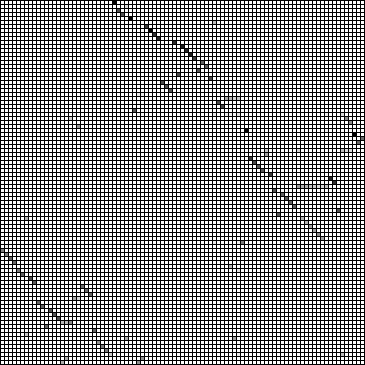
Then if we represent a term in the look-and-say sequence as a vector v with its ith entry being ci × ℓi, where ci is the number of times the subsequence (i) appears in that term, we find that the sum of the entries in v is the total length of that term of the look-and-say sequence. More important, however, is the fact that the sum of the entries in Tv is the length of the next term in the look-and-say sequence. The sum of the entries in T2v is the length of the next term in the look-and-say sequence, and so on. So we have found a degree-92 recurrence relation for the length of terms in the look-and-say sequence, and the corresponding transition matrix is T.
Computing the Limit
It is a basic fact of linear homogeneous recurrence relations that a closed-form solution to the recurrence relation can be written down in terms of the eigenvalues of the transition matrix (see the linked Wikipedia page for specifics). As a corollary of this, the limiting ratio of terms in the sequence is equal to the spectral radius of the transition matrix. Fortunately, the transition matrix in this case is quite sparse, so its characteristic polynomial isn’t too difficult to compute:

Indeed, the degree-71 polynomial that λ is a root of is one of the factors of the characteristic polynomial of the transition matrix T. All that remains to do is to get MATLAB to compute the largest root of that polynomial (i.e., the spectral radius of T):
>> max(abs(eig(T)))

ans =
    1.303577269034287
The matrix T is attached below for those who would like to play with it. Something fun to think about: what do the rational eigenvalues (-1, 0, and 1) of T represent?
Download: Transition matrix [plaintext file]
Update [March 17, 2013]: Entry 91 of the subsequence table has been corrected – thanks to Marcus Stuhr and liuguangxi for the correction.
That polynomial is a thing of beauty! I have often seen the sequence, 1, 11, 21, 1211, 111221, 312211, used as a fun math puzzle, but I have never seen it examined with such depth. I also did not know that it was called “look-and-say” sequence. Is the Conway mentioned in your title John Horton Conway of Conway’s Game of Life fame?
@WebsterLin – That is indeed the same Conway. Quite a guy 🙂
Pingback: Matrix67: My Blog » Blog Archive » Conway常数是怎么得来的?
Pingback: Look And Say, Revisited « Programming Praxis
Pingback: Look-and-say y la constante de Conway | Gaussianos
I guess the max root 1.3035… is an irrational number? (afaik MATLAB cuts off the number after the 15th decimal by default, thus suggesting the number to be rational)
@andy – Yes, it’s irrational. The rational root theorem says that the only possible rational roots of that degree-71 polynomial are ±1, ±2, ±3, and ±6. Plugging those values into the polynomial reveals that none of them actually are roots, so it has no rational roots.
to anyone who may want to use this page for any reason… there is exactly one error in the big table
Entry 91 is incorrect
Entry 91 should be 312211322212221121123222112
What reason would that be? 😀
Thanks for the blog post and thanks for the correction!
Correction to 91 has messed up the ordering. If (and only if!) you wish to restore the lexical ordering, the atoms at entries 90 & 91 should be swapped. Their descendants are respectively 35 and 36, and the descendants of 16 17 35 and 36 would also then need amending to respectively: 80 28 89, 80 28 90, 23 32 60 28 89, 23 32 60 28 90 (omitting the brackets). I’d been using the Conway ordering, so it’s worth checking whether I’ve amended my indexes correctly.
I tried to compute this in Python starting from the 8th term and using a transition matrix at power n-8. My results arre correct until the 27th term and the 28th is false. What do you think can be wrong ?
Sorry for that. I just corrected my mistake. I was thinking that there were only 1 in the transition matrix. I missed that (29) appears twice in the evolution of (60).
Here is a thought the signification of the rational eigenvalues.
Taking a vector of α(90)-α(91)+β(35)-β(36), thinking of it as a real quantities of elements 90,91,35 and 36, it becomes after applying the sequence α(36)-α(35)+β(91)-β(90). So with β=α, we get an eigenvector for the value -1.
Of course (61) is an eigenvector for the value 1…
It requires more work to get an eigenvector for the value 0, or to get the dimension of the eigenspaces.
It also works with β=-α to get an eigenvector for the eigenvalue 1…
Empirically it is clear that the growth rate tends to the spectral radius, but how can this be rigorously proven?
Equivalently, how can it be shown that the vector corresponding to the eighth element has a component in the direction of the largest eigenvalue in the Jordan basis? (Remember, it’s not orthogonal in general.)
How were the elements derived? It seems like a rather difficult task..
@Andrew – Computer search carried out by Conway. The original code that carried out the search is long gone, but Ekhad and Zeilberger independently re-did the search much later, and their code is available here.
Pingback: Growth of recursive string substitution | Complex Projective 4-Space
Where do I find the irrational number of Conway’s Constant? I’ve only been able to find the decimal representation and the polynomial that has it. Has anyone gotten the exact closed form representation for the constant?
@Neil – There almost definitely *isn’t* an exact closed form representation for it. Roots of polynomials of degree 5 and higher often can’t be expressed exactly using things like plus, minus, multiplication, and roots (this is the Abel-Ruffini theorem), so it would be quite a surprise if this root of a degree-71 polynomial could be.
Oh ok. Thank you Nathaniel.
What are real life applications of this sequence?
Bonjour ,
je préfère la suite SW ( Say and Write de Planchon)
neuf(9) fois neuf(9) = 81
999 999 999 =81
et 1/81 = 0.012346790123…. période 9
puis 2/81,3/81 etc …
ou
trois(3) fois six(6) = 18
666 = 18
etc a new multiplication table !!!!!
see my blog and leave comments :
http://flechedutemps.blogspot.fr/
The univers is numbers.
Many thanks
Great article. Anyways, I assume the value 1 represents that if the sequence starts with “22” instead of “1”, then the ratio of the length of each term is 1 instead of 1.303,
According to oeis.org/A014715, the last decimals of the above value from Matlab are not correct. Following the links, there is further information available.
How is it shown that the successor of a string consisting of a sequence of these atomic strings is itself a sequence of atomic strings?
Denote the seeit-sayit transformation by s, so s(1221) = 112211, etc.
The basic fact that lets pieces of a string evolve independently is that if S(A) = B, S(C) = D, then S(AC) = BD just if the last digit of A is different from the first digit of B. But how do you show that this never happens when starting from a sequence of the 92 atoms? There are atoms that end in 1, and others that start with 1; how do you show that you will never get those adjacent to each other when applying s to a sequence of atoms?
@Andy Latto – By brute force computation. You can just track the paths of all 92 subsequences and see that you never end up getting a sequence that ends in 1 followed by a sequence that begins with 1 (for example). This is why where are 4 subsequences starting with “132211331”. That substring alone isn’t included in the list of 92 because how it evolves depends on what digits come after it.
Pingback: Why is the Conway ‘Look and Say’ sequences constant defined by this polynom? – Math Solution
One one was a race horse
Two two was one too
One one won one race
Two to won one too
Great article! I just don’t understand why the limiting ratio of the terms of the sequence is necessarily the largest eigenvalue of the transition matrix (even if it seems obvious empirically). I’ve looked at the linked Wikipedia page but can’t seem to find this information on it.
@Clément
Hi, Clément. It’s because the eigenvalue with the maximum absolute value will, over the course of iteration, have the greatest effect on the vector that T acts upon.
Pingback: ติดเน็ตบ้านทรู
Pingback: corona cigars Canada